
Picture a classroom in Shanghai. Grade 9. A teacher asks students to hold up mini whiteboards showing their answers. She scans the room. Six students have it wrong. She nods, says "good effort everyone," and moves on.
I was in that school last week. And I've seen versions of that moment hundreds of times.
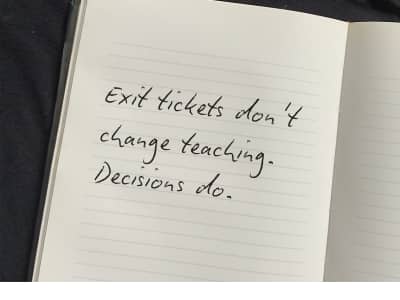
It's not that she didn't care. She'd done exactly what the training said. Gather evidence of learning. Check for understanding. Use the tool. What nobody had taught her was what to do with what she found. The instrument was there. The action wasn't.
This is the quiet failure inside most formative assessment programmes. Teachers use the tools conscientiously, exit tickets, diagnostic questions, mini whiteboards. But interpreting what you find, making a decision, following through, and checking whether it worked? That part gets skipped. Not because teachers are lazy. Because nobody ever modelled it.
Valentina Devid, who co-authored Formative Action, reframed this for me entirely. In the Netherlands, they stopped using the phrase "formative assessment" altogether. The word assessment was the problem. Teachers heard it and immediately thought of testing, data, judgement. So they replaced it with formatief handelen: formative doing. The emphasis lands exactly where it needs to, on the action that follows the evidence.
Schools that genuinely grasp this distinction start to look different. Teachers don't just ask the question and move on. They anticipate the likely misconceptions before the lesson. They know what they'll do when half the class has it wrong. They've already thought about those thirty seconds after the mini whiteboards go up, before they're even standing in the room.
Think about your own school. Does everyone share a clear picture of what should happen in that window?
That gap between the instrument and the action is where most improvement efforts quietly die.
If you're in Asia and want to work through this properly, Valentina and I are running a full-day workshop in Shanghai on April 24th. She co-wrote the book. I work on implementation with school leaders every day. It's not often those two things are in the same room. The details are here.
Wherever you are though, here's something worth doing next week. Ask a few of your teachers what they do with the information they gather during lessons. Not which tools they use. What they do next. The answers will tell you exactly where your programme actually stands.
That's the real starting point.
Reply and tell me what you're seeing. I read everything.
Shane
Listen to the latest episode
Click here to listen to this week's episode of my chart-topping podcast, Education Leaders