
You’ve just watched a lesson. The form in front of you has seven things on it and the teacher has done five. You could name the missing two in ninety seconds and be out the door, and it would feel like helping.
I’ve done exactly that. Not because I thought little of the teacher, but because it was March, something was due, and I wanted things to move.
Jim Knight has a description for what those ninety seconds do. They treat a teacher like someone stocking shelves rather than someone with discretion. Jim wrote the first article on instructional coaching and then the first book, and he’s spent thirty years at the University of Kansas researching what actually shifts practice, so he has watched a lot of leaders do a lot of telling.
His account of why we do it is more generous than I expected. There’s a small hit that comes with giving advice. Someone’s situation is messy, we want to tidy it up for them, and then when they don’t do the thing we quietly file them under resistant. Feeling good and doing right arrive in the body the same way, which is why they’re so easy to confuse when you’re under pressure.
He isn’t sentimental about that pressure either. He runs a company, and he was honest about how it feels when he thinks people are dawdling. He was equally clear about what heads carry. In parts of America the scores go in the newspaper. In an international school you might simply not have the students next year. And the moment you become the boss, people stop extending you the compassion they extended you the year before, while the person above you starts treating you like an object rather than a person.
None of that makes a quick fix the right call. It just explains why the quick fix is so tempting.
Jim quoted one of my favourite thinkers, Dan Pink, on teachers being the most motivated group he’s ever come across. The ones in the stationery shop in late July, spending their own money on a classroom they aren’t contractually required to think about for another five weeks. Jim’s view is blunt: if you can’t see that in the people in front of you, you have no business running professional learning for them.
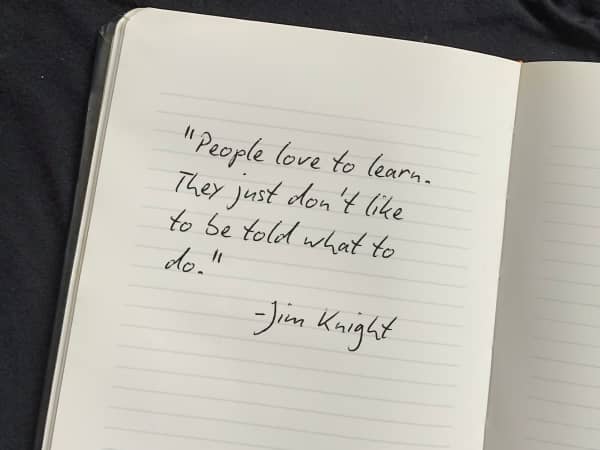
“People love to learn. They just don’t like to be told what to do.”Autonomy isn’t an opt-out, though. There are cultural norms, there are things a system requires, there’s a pedagogical approach a school has agreed together. Continuous improvement sits inside all of that as a permanent feature of being a professional, the way three sides are a permanent feature of a triangle. You wouldn’t want a doctor who told you she hadn’t changed anything in fifteen years. What’s up for negotiation is which bit you’re improving, and who chose it.
So the small thing to try. Next time someone asks you to just tell them what to do, say you’ll share some thoughts in a minute, but you want their thinking first. If they’re genuinely stuck, scaffold it. Do you mind if I put two or three options on the table and you tell me which one sounds like yours. Most of the time they’ll arrive at the thing you were about to say anyway, and then it belongs to them. In my experience that’s the version still happening in November.
The full conversation with Jim is episode 174. He also walks through the four conversations he uses to get a teacher from watching video of their own lesson to a measurable goal, which is worth the listen on its own.
Do reply and tell me how it lands. I read everything.
Shane
PS The September cohort of the Education Leaders Intensive is filling up. There’s a payment plan if that makes it easier.
Listen to the latest episode
Click here to listen to this week's episode of my chart-topping podcast, Education Leaders